

M.A.M.A. Issue n.46 - Dr Christina Kolaiti and Melisa Cahnmann-Taylor
Procreate Project, the Museum of Motherhood and the Mom Egg Review are pleased to announce the 46th edition of this scholarly discourse. Literature intersects with art to explore the wonder and the challenges of motherhood. Using words and art to connect new pathways between the academic, the para-academic, the digital and the real, as well as the everyday: wherever you live, work and play, the Art of Motherhood is made manifest. #JoinMAMA #artandmotherhood
May 2021: Art and words by Dr Christina Kolaiti, Poetry by Melisa Cahnmann-Taylor
Art by Christina Kolaiti
‘Three Degrees of Separation’
This body of research challenges the conflicting landscape of early motherhood, as this is conveyed through social prescriptions, which interpret the body as a metaphor for self-worth and aim at controlling the mother-infant physicality. This norm is in fact experienced through three progressive stages of physical and emotional separation between mother and infant, opposing the fundamental principles of healthy attachment i and can result in breastfeeding grief, separation anxiety and trauma.
Early weaning, the cot-centred sleep training culture and the introduction of the infant to day care are three progressive stages of physical separation. Such conventions discourage “interdependence with high parental contact” ii and define three modes of cry it out iii experienced mutually by the infant and also, the mother. This body of research holds an opposing view and strives towards a more natural approach to the mother-infant relationship through maximised physical closeness in both daytime and night-time parenting practices.

The installation presented at Dalby Forest during SelfScapes 2021 v reveals the social construct of separateness as a misleading connotation of independence, which is exposed by the disturbing melancholy of the aloneness of the cherished handmade teddy bear.
If unattended long enough, babies stop crying because “they are simply giving up on the hope that comfort will come.” vi Vulnerable to the wilderness of the forest, the solitary presence of the delicate milk-coloured teddy bear, signified an unexpected encounter for the walkers. Yet, the bear is not alone.
This sighting (the infant-mother teddy bear) provoked an affectionate response from people who began to share images of keeping the bear company and temporarily making it part of their family. It was as if this natural encounter with separateness “reawakened a deeply instinctive way” of relating, or in other words parenting ” […] as nature intended: a true source of contact, security and warmth […].” vii


The walker’s portraits show an unplanned demonstration that secure attachment is as much nurtured in the physiological infant-mother closeness, as are the social aspects of this relationship. viii Likewise, this substantiates that co-nurturing interdependence is as much a responsibility of the prime caregiver as it is epitomised by communal affairs, representing a “lasting psychological connectedness between human beings.” ix By embracing our innate instincts, we can collectively re-instate the balance between intuition and convention.
“It takes a village to raise a child.” x
Notes:
i Bowlby, J. (1969) Attachment. Attachment and loss: Vol. 1. Loss. New York: Basic Books.
ii McKenna, J. J. (1996) ‘Babies Need Their Mothers Beside Them’, The Natural Child Project. Available at https://www.naturalchild.org/articles/james_mckenna/babies_need.html
iii Burbridge, A. (2016) ‘Letting babies cry-the facts behind the scenes’, La Leche League GB. Available at: laleche.org.uk.
v SelfScapes is an arts initiative, which explores the relationship between the self and the natural environment. Dalby Forest, March-June 2021. The project is supported by The Arts Council England and Forestry England.
vi Burbridge, A. [Ibid.]
vii Maté, D. G., Neufeld, G., (2019). Hold on to your kids: Why parents need to matter more than peers. United Kingdom: Ebury Publishing.
viii McKenna, J.J. [Ibid.]
ix (Bowlby,1969:94).
x African proverb, which proposes parenting as a communal responsibility.
More about Christina:
Dr Christina Kolaiti is a Senior Lecturer in Photography at York St John University. She is a visual artist whose research has been based on interdisciplinary collaborations with healthcare institutions. For over a decade Kolaiti’s research activity has positioned the narrative properties of fine art photography within a diverse range of scientific and pedagogical contexts.
Her research profile includes exhibitions set within various hospital sites (for example, The Northern Surgery Skills Institute at Hexham General Hospital and The Royal College of Physicians in London). She has received research awards by The Arts and Humanities Research Council, The Arts Council England, York St John University and most notably, The Combined Royal Photographic Society and Royal Medical Colleges Medal in 2011, ‘[…] for an outstanding contribution to the advancement of the art and science of photography.’ (rps.org)
Words by Melisa Cahnmann-Taylor
Home Isolation, Day 42
I open my son’s door.
It smells of boy funk, dog, and morning breath.
When I ask: Do you need any help?
I mean tornados, fractions, conjugations but I also mean interrogations of the gentler kind:
How are you doing? What do you miss? How can I substitute for your losses?
A dirty sock, whirring
laptop, abandoned
saxophone case-less, exposed,
today put nothing away.
More about Melisa:
Melisa Cahnmann-Taylor, Professor of Language and Literacy Education at the University of Georgia, is the author of Imperfect Tense (poems), and three scholarly books in education. Winner of NEA Big Read Grants, the Beckman award for Professors Who Inspire, and a Fulbright for nine-month study of adult Spanish language acquisition in Oaxaca Mexico, she’s served for over ten years as poetry editor for Anthropology & Humanism, judging the ethnographic poetry competition. She blogs at http:// teachersactup.com.


M.A.M.A. Issue n.45 - Rubiane Maia
Procreate Project, the Museum of Motherhood and the Mom Egg Review are pleased to announce the 45th edition of this scholarly discourse. Literature intersects with art to explore the wonder and the challenges of motherhood. Using words and art to connect new pathways between the academic, the para-academic, the digital and the real, as well as the everyday: wherever you live, work and play, the Art of Motherhood is made manifest. #JoinMAMA #artandmotherhood
April 2021: Art and words by Rubiane Maia
For the last three years, I have been investigating the concept of memory and its resonances in our way of existing. More specifically, focusing on the philosophy of Time proposed by Henri Bergson, which affirms memory as duration. In other words, it deals in depth with the subjective time that implies the continuous relationship between our consciousness and the world. This means that our consciousness (which is also memory) is not linear, as it is constituted on the indivisibility of past and present. In Bergson’s words, ‘duration is the continuous progress of the past that gnaws the future and swells as it progresses’. In my opinion, this sentence precisely confirms the hypothesis that memory cannot be configured as a drawer where remembrances are saved, because as the past is preserved by itself as a virtuality that coexists with us, it accompanies us entirely: each one of us is the condensation of the history lived since birth – and even before it.
This notion that the past is a vital force that moves incessantly, coexisting and actualising itself through our bodies continuously has been a fundamental aspect in my current artistic production. I am particularly interested in the concept that the moment a memory is actualised through an action, it ceases to be a memory, becoming perception again. In this sense, the body becomes the device that launches us towards any future. In summary, consciousness is memory. Memory is duration. Duration is a continuous flow. This moving force is what unites the material and spiritual world. On the other hand, if we point these concepts in the direction of Indigenous Cosmologies, none of this is new. However, as we were born and grew up in a westernised world with numerous layers of violence and oppression, we are used to see the hegemonic perspective. Decolonizing memories takes a lot of effort. Effort to escape from the comfortable place of rationality. Effort to regain the vital impulse of the body that acts, that resignifies, that reorganizes time and life.


* Photographs by Manuel Vason
DISSOLUTIONS
our bodies inhabit landscapes
even on mainland,
we follow the speed of the fish
arms take the form of dorsal fins
legs, tails
we are submerged,
drunk with salt water, contradictions and algorithms
our scaly skin burns, stings
it is true that not all parts of the body fit together – –
becoming-creature, becoming-noise, becoming-mud
the ocean is full of mythologies
hybrid beings,
bird fishes, jellyfishes, hammerhead sharks
in the middle east,
mermaids are goddesses of the sea, of vegetation and rain – –
they smell of dew
in some places in Africa,
they are stormy forces that mobilize the energy of creation
Mameto – Dandá – Kianda – –
Dandalunda, mãe-d’água, Odoyá!
our bodies not only inhabit,
they breath the landscapes
turbulent waters,
urine – giant waves – undertow – –
my fins fold in different directions at the same time
unlike fish, i have lungs:
two spongy cones that I use to filter the air
yes, i breathe,
i, us, the fishes and some other creatures
we breathe, even against our desire
involuntary act,
first and last movement of the life
vortex between birth and death
a gentle breeze comes in through the nostril,
fills the chest,
activates the diaphragm,
moves your tongue,
vibrates
thus, the voice is born
from voice to song, from song to word, from word to scream
our bodies not only breathe,
they become landscapes
from each breath a mountain emerges,
hills – dunes – stones – –
presence
organs are territories,
complex systems, regions
they make mazes and borders
they form valleys, subtle surfaces, rivers and lakes
every mouth is an abyss,
an endless hole
rough skin, dry leaf
dark eyes, fissures
anus, tunnel
blood, current
sweat, combustion.
sneeze, storm
feet, roots
bones, architecture
breath, gust of warm wind
body-landscape
landscaped bodies
we inhale, suspend, count to five
we exhale, suspend, count to four
we inhale, suspend, count to three
silence
we count to two, expand
one
i am breathing as someone that turn the key,
shifting worlds to open and close the body
physical, mental, emotional,
rupture – interference – happening – –
action that operates in the invisible,
in a constant process of variation
difference
breathing is to metabolize,
dissolving all forms, segments, rules, institutions.
breathing is channeling,
an offer from you to you – sensitive laboratory – –
an unpredictable device
vivid dreams
sigh
More about Rubiane:
Rubiane Maia is a Brazilian visual artist based between Folkestone, UK and Vitoria, Brazil. She completed a degree in Visual Arts and a Master degree in Institutional Psychology at Federal University of Espírito Santo, Brazil. Her artwork is an hybrid practice across performance, video, installation and text, occasionally flirting with drawing and collage. She is attracted by states of synergy, encompassing the invisible relationships of affect and flux, and investigates the body in order to amplify the possibilities of perception beyond the habitual. By doing so, she is constantly re-elaborating her personal notion of existential territories (spatial, temporal, cognitive, social and political). More recently, she has been researching the concept of memory and its relationship with language and the phenomena of incorporation [embodiment], often making use of personal narratives as a device for action and resilience.
In 2014/15 she received a scholarship at the Atelier in Visual Arts of the Secretary of Culture of Espírito Santo, she launched the book ‘Self Portrait in Footnotes’ and participated in the exhibition ‘Modos de Usar’ at the Museu de Arte of Espírito Santo. In 2015, she took part at the workshop ‘Cleaning the House’ with Marina Abramovic and participated at the exhibition ‘Terra Comunal – Marina Abramovic + MAI’, at SESC Pompéia, São Paulo with the long durational performance ‘The Garden’ (2 months). In the same year, she produced her first short film ‘EVO’ that premiered at the 26th Festival Internacional de São Paulo and 22nd Festival de Cinema de Vitória. In 2016, she worked on the project titled ‘Preparation for Aerial Exercise, the Desert and the Mountain’ which required her to travel to high landscapes of Uyuni (Bolivia), Pico da Bandeira (Espírito Santo/Minas Gerais, BRA) and Monte Roraima (Roraima, BRA/Santa Helena de Uyarén, VEN). In the same year she completed her second short film titled ‘ÁDITO’. Since 2018 she has been working on the creation of a ‘Book-Performance’, a series of actions devised in response to specific autobiographical texts particularly influenced by personal experiences of racism and misogyny.

M.A.M.A. Issue n.44 – Alexis Soul-Gray and Iris Jamahl Dunkle
Procreate Project, the Museum of Motherhood and the Mom Egg Review are pleased to announce the 44th edition of this scholarly discourse. Literature intersects with art to explore the wonder and the challenges of motherhood. Using words and art to connect new pathways between the academic, the para-academic, the digital and the real, as well as the everyday: wherever you live, work and play, the Art of Motherhood is made manifest. #JoinMAMA #artandmotherhood
March 2021: Art by Alexis Soul-Gray, Poetry by Iris Jamahl Dunkle
Art by Alexis Soul-Gray
Alexis’s practice is concerned with loss, memory and grief. Speculative questioning about the memorial, memory and commemoration brings together a conjecture of imagery taken from personal and public archival materials. Through painting, collage and print the artist defaces and rearranges found images and objects. Soul-Gray explores themes of loss and grief with a particular focus on the trauma caused by the loss of the mother figure, questioning notions of domestic success and the cuteness inherit in memory, she uses destruction and abrasion to physically manipulate and alter found images in order to find new realities, a calm after a storm…a final resting place that cannot be reached.


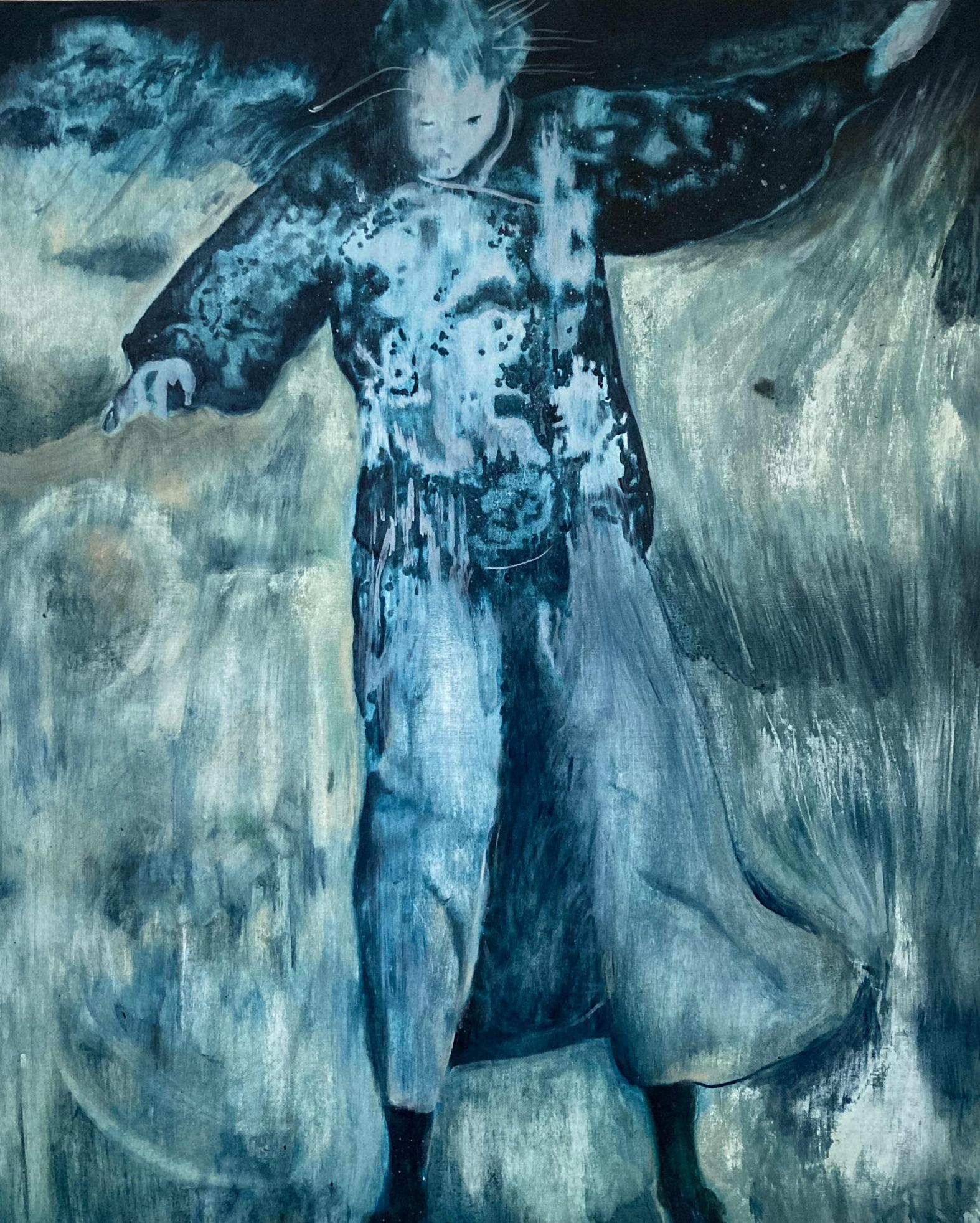
I work on canvas, linen, wood and paper. I have recently been drawn to salvaged found paper ephemera such as vintage embroidery transfers, bible pages, knitting patterns, objects of beauty and magazines/books that give advice/ instruction for domestic success. I often work in layers, deliberately interrupting images through overlap/obstruction as an attempt to create a visceral representation of the thought process. Abstraction and figuration hold equal significance. Images are continuously intersecting, abrasive, harmonious, removed…a tangible manifestation of a multi-layered interior state.

I am interested in the stillness found in studio shot images of children and women, floristry, knitting and antiques. Almost like puppets and dolls in play, I take them on a journey of change and exploration. These images were not designed to be used in paintings, their intended use was cheap printed instructional material and quickly forgotten books. Many of the images I work with date from the 1930’s-1980’s, they represent personal ancestry, collective histories, traditions and loss.


More about Alexis:
Alexis Soul-Gray is a visual artist based in Devon, UK. Her practice sits predominantly within painting, drawing and printmaking but also includes assemblage, photography and film. Alexis studied at Central Saint Martins and Camberwell College of Art, has completed the postgraduate year at The Royal Drawing School and later this year will start her MA in Painting at The Royal College of Art after 10 years of primarily caring for her two daughters. Alexis has worked in Arts education for 17 years and currently holds a lecturing role in Devon. She has also worked as a curator, producing 3 large scale art events in unusual settings including an old village post office in rural Oxfordshire, the vaults of an Elizabethan mansion in Epping Forest and an inner city folly standing adrift, lost in Birmingham city centre, built in memory of the land owners deceased wife.
Poetry by Iris Jamahl Dunkle
Mother Song
Had I sky enough, had I sea, I’d pour
that blue back into you, my second hearts.
Each dawn brings a symphony of swallows mud-nested in the eaves. A reckoning:
what dulls can shine out, have you wings and lungs.
In this house of loss and shadow, we mass
the store of what we’ve learned: Even winter-
bare buckeyes will green and bloom out. Hawks
will nest in ribbons of air. The monarch
butterflies will shock our eyes with orange wing.
More about Iris:
Iris Jamahl Dunkle is the author of three poetry collections, including Interrupted Geographies (Trio House Press, 2017). Her biography about Charmian Kittredge London, Jack London’s wife was published by the University of Oklahoma Press in 2020. She was the Poet Laureate of Sonoma County from 2016-2018. She teaches at Napa Valley College and is the Poetry Director of the Napa Valley Writers’ Conference.