Mother Art Prize 2020 Winner and Show finalists

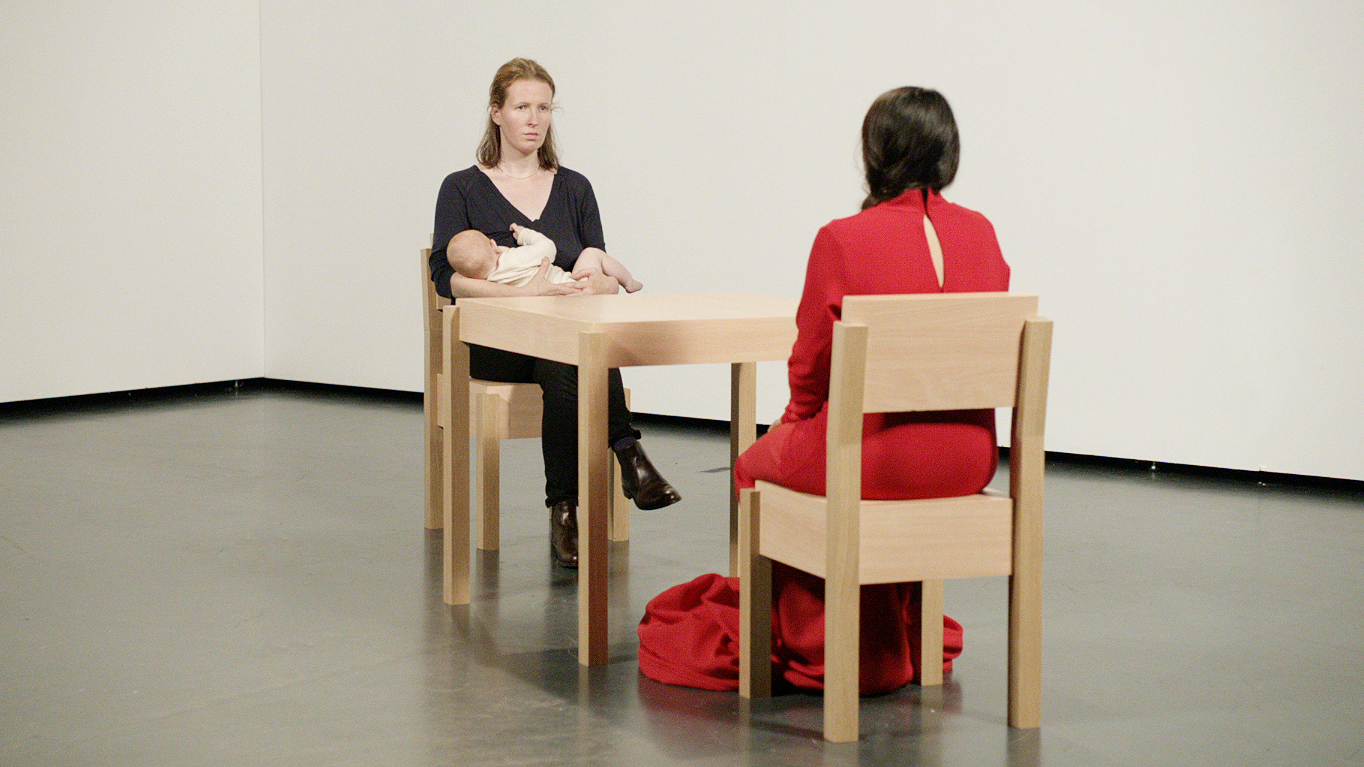
We are thrilled to announce that Helen Benigson is the winner of the Mother Art Prize 2020 with the video piece ‘Jude’.
Winner’s Award: £500 Cash Prize kindly supported by Diversity Art Forum + 2-week solo exhibition at The Showroom in summer 2021
Jude addresses the transformation of an Orthodox Jewish Rebbetzin (Rabbi’s wife) in a British Synagogue to a single, non-binary person coming to terms with their parenthood, religious identity, sexuality and gender, using the Internet as a way of forging new possibilities for their existence and self-expression.
The online award goes to Violet Costello
Online Award: Online Exhibition with Richard Saltoun [Sept 2020] + 2 mentoring sessions with Sylvie Gormezano, Director at Picture this productions and Chair of the Association of Women Art Dealers (AWAD)
The International Award goes to Eileen Reynolds
International Award: Up to 4 weeks residency in London + £500 worth of art materials sponsored by Colart


We are pleased to introduce you to the other group show finalists:
The Group show will take place at Elephant West, Elephant Magazine’s pioneering project space in west London [6-29 of November 2020 subject to COVID-19 alterations]; The finalists artists and awards winners will be featured in the Procreate Project online shop and in the Elephant Magazine.
Our special thanks go the judging panel for their hard work and dedication during these unprecedented times.
-
Niamh Coghlan, Richard Saltoun Gallery Director
-
Pauline Desouza, Director of the Diversity Art Forum
-
Elvira Dyangani Ose, Director of The Showroom and Lecturer in Visual Cultures at Goldsmiths University
-
Eva Langret, Artistic Director Frieze London
-
Claire Mander, Chair of Steering Committee of UK Friends of the National Museum of Women in the Arts and Director of theCoLAB
-
Frances Morris, Director of Tate Modern
For any enquiry please contact us us at artprize@procreateproject.com

Our partners and sponsors:


M.A.M.A. Issue n.41: Michele Landel and Ann E. Wallace
Procreate Project, the Museum of Motherhood and the Mom Egg Review are pleased to announce the 41st edition of this scholarly discourse intersects with the artistic to explore the wonder and the challenges of motherhood. Using words and art to connect new pathways between the academic, the para-academic, the digital, and the real, as well as the everyday: wherever you live, work, and play, the Art of Motherhood is made manifest. #JoinMAMA #artandmotherhood
March 2020: Art by Michele Landel Words by Ann E. Wallace
Art by Michele Landel
For There She Was, comes from the last line of Virginia Woolf ‘s “Mrs Dalloway” and includes over a hundred embroidered, burned, dyed and collaged images. The series emerged from thinking about all the women who are currently speaking out about their pain and trauma and are refusing to go away. To summarize this moment, Michele brewed natural dyes in her kitchen using organic materials and then dyed small scraps of fabric (a cloth baby diaper, an antique tablecloth, a stained tea towel…) to represent the physicality of womanhood and gender roles. She matched the fabrics with small paper dolls that are digitally edited photographs from clothing catalogues to show the commodification and manipulation of women’s stories. To deliberately erase the women, she burned holes in the photographs and repeatedly stitched over their faces and bodies. Yet the women are still there. Their presence is even stronger.


Who’s Afraid is intended to capture the tension between men’s anxiety of being unreasonably accused of inappropriate behavior and women’s fear of sexual harassment and assault. It is referencing the play “Who’s Afraid of Virginia Woolf?” and the inherent tension between actors and audience that is part of a theater performance and in this play the volatile and complicated relationship between men and women. To capture this, Michele started with the gaze. Specifically the ‘male gaze’ as defined by the feminist film theorist, Laura Mulvey. She began with a photograph of an anonymous woman from a clothing catalogue. The photograph fits interestingly within Mulvey’s three phases of the ‘male gaze’: How men look at women, how women look at themselves, and how women look at other women. She enlarged the photograph, divided it into small rectangles, and then printed the image on secondhand bed sheets. She pieced the photograph back together and painted, using machine embroidery, the woman onto a second bed sheet – covering her skin, hair and clothes with thread. She cut out the woman’s eyes to make the viewer uncomfortable and scared. Deliberately referencing childhood ghost costumes made by cutting out eyeholes from old bed sheets, she is engaging with the idea of spectator and specter both of which have the Latin root word ‘spect’ meaning to ‘see.’ From a distance the embroidered figure on the sheet appears three-dimensional. The embroidered figure appears to ‘see’ the viewer when in fact the gaze is empty. The vacant gaze causes anxiety and feels powerful.


More about Michele
Michele is an American artist. She holds degrees in Fine Arts and Art History. Her work has been exhibited in Europe, the UK, and the US and she is extremely proud to have been in the 2017 Mother Art Prize group show. She was awarded the 2018 Innovative Technique Award by the Surface Design Association and is represented by the Jen Tough Gallery in Santa Fe, NM and the Muriel Guepin Gallery in NYC, NY. Her upcoming art events include Imagining Identity: Contemporary Textiles at the Palo Alto Art Center Foundation in Palo Alto, CA and the Hankyu Paris Art Fair in Osaka, Japan. Michele has lived in France for over 15 years. She has three school-age children and works out of her art studio in the Paris 9th arrondissement.
Words by Ann E. Wallace
Closed
Close the door.
She looks at me like I am ridiculous.
But I only left it open for a minute.
A girl raised by a father has not
had to think much about the reasons
a family of girls keeps the door closed
and locked.
A family of girls knows
the unwanted will enter
closed doors, will penetrate locks
uninvited.
We do not need to leave
the door open for them.
More about Ann
Ann E. Wallace writes of life with illness, motherhood, and other everyday realities. Her poetry collection is Counting by Sevens , from Main Street Rag, and her published work, featured in journals such as Wordgathering, The Literary Nest, Rogue Agent, Mothers Always Write, and Juniper, can be found on her website AnnWallacePhD.com. She lives in Jersey City, NJ and is on Twitter @annwlace409.

Mother Art Prize catalogue 2018 Introduction
Mother Art Prize 2018 – Catalogue Introduction written by Marcelle Joseph, Elizabeth Neilson and Laura Smith
In 1976, feminist art critic Lucy Lippard wrote about the dearth of imagery related to pregnancy or childbirth in artworks made by women artists. Lippard explored the reasons why procreativity was such a taboo in women’s art at the time: ‘Is it because…women artists have traditionally either refused to have children or have hidden them away in order to be taken seriously in a world that accuses wives and mothers of being part-time artists? Or because the biological aspect of female creation is anathema to women who want to be recognised for their art?’ In the same year, notable American conceptual artist and feminist Mary Kelly exhibited her six-year exploration of the mother-child relationship, Post-Partum Document (1973-1979), at the ICA in London.
For this year’s Mother Art Prize, the open-call did not request artworks focusing on any specific theme – just artworks made by self-identifying women and non-binary artists with caring responsibilities. Looking at the work on display in this exhibition by the twenty shortlisted artists for the Mother Art Prize 2018, won by Candida Powell-Williams, a large proportion of these artists presented artworks with imagery related to motherhood topics such as conception, pregnancy, breastfeeding and other mothering labour. Another common thread in these artworks is the depiction, either figuratively or conceptually, of the female or non-binary femme body. These twenty artists who are also mothers prove that nothing is taboo, and a mother’s lived experience is as worthy a subject as any other for representation in an artwork.
As the early years of the 21st century get into gear, there is a hope for the complete recognition of gender as a social rather than a biological construct. This in turn would take the labour of mothering, in all its forms, away from being ‘women’s’ work and into the mainstream marketplace. If anyone can birth, then everyone needs to take responsibility and therefore make space for it in their lives. Arguably, this is in progress as shared parental leave is now widely accepted, and many male identifying individuals take on the role of primary carer. What is clear is that this journey has not started for many people – we are still convening in the carpark before the exodus up the hill. Whilst a privileged few are primed and ready to explore new territories (non-binary queer bodies are at the head of the expedition), many are still attempting to tackle the difficult definitions that have been foundational for the past century and are still very real barriers to equality. Feminism, the gender pay gap and how socially inscribed bodies have been made to limit rather than empower us are all issues that proliferate in the shortlisted works.
But what about birthing? Are we really beyond our bodies? Mothering or caring is the long-term act but the short action that leads to life creates communities and also victims as its understanding is tainted by Hollywood and the Call the Midwife/One Born Every Minute TV versions of birth. The universal constant in the birthing process is that it brings you back to your body. The miracle of life – however it plays out – requires the human body to do something entirely physical. Public visibility is needed in the world for self-identifying mother artists because their invisibility allows the ignorance of mothering in all its guises. Bodies are sexual; they are horrific; they are creative; they are abject. They are not objects. They are active, and the social body of ‘woman’ joins many of the artists across the exhibition. Only two works are truly abstract and, still within that definition, these works arguably conjure a ‘feminine’ bodily experience of abstraction. Maria Lassnig (1919-2014), an artist who throughout her long career sought to paint representational portraits of what it felt like to be alive, also strove to expose the embarrassment and uncomfortable psychic physicality of being a human in a society – and by extension – of being a ‘woman’. Coining the terms Körpergefühl (body sensation) and Körperbewusstsein (body awareness) to describe her work, Lassnig created moments that vibrate with something indescribably visceral.
Mothering ought to be a universal experience because communal as well as individual care for our young is surely part of civilised society. And birth, from the varied possible perspectives, could and should join all involved in the active conception, birthing and parenting labour that is inherent in child rearing. As the idea of what is possible to conceive as gestational or birthing experiences expands (whether it be caesarean sections, surrogacy, adoption, free-birthing or IVF), each social and medical advance has increasingly allowed adaptation of this section of the human life cycle. Cyborg bodies are becoming increasingly normalised; plastic and cosmetic surgery are increasingly accepted as essential (straight white teeth and 20/20 vision are becoming basic human rights – for the rich) so we should not expect birth and child rearing to be outside the sphere of science. At this time of change, inclusion rather than exclusion is the position of power and community engagement. An expanded understanding of mothering in all its forms is essential to communities today.
The Mother Art Prize recognises and embraces this need for inclusion while also – essentially – providing opportunities and options for those who identify as mothers to evolve their careers as artists, a vital but often overlooked necessity. And a necessity that was recognised by the influential American artist Anne Truitt (1921-2004), who at the age of 53 confronted the awkward finitude she felt at staging a major retrospective of her work, by keeping a diary in which she wrote diligently for seven years. Eventually published as Daybook: The Journal of an Artist, her writings chart both her explorations of herself as a late-career artist as well as the period in which she became a grandmother for the first time, causing her to interrogate the duality of her life as a mother and an artist:
The new balance my children’s maturity is bringing to my life makes me wonder about the differences that seem to be surfacing between the artist in me and the mother. The artist struggles to hold the strict position she has found keeps her work to a line she values while the mother is trying to grow by adjusting to the rapidly changing conditions my children present me as they move out on what seems to my schematic mind a sharply rising trajectory: They are learning a great deal about a great many aspects of life very fast. What they apparently expect from me is a point of view. They ask questions and they want what answers I can give. The artist’s answers are only rarely useful to them. And the positions from which they ask are often different from those I have been in myself, so I have to use my imagination to empathize. This is taxing. At the same time I must maintain a center in myself so that what I say is honest… I am wondering now if some third person who is neither artist nor mother, as yet unknown, unnameable has developed behind my back… If so, her mode of being is tentative.
The Mother Art Prize and its parent, the Procreate Project, are such valuable assets to our current cultural landscape. Amidst these times of change, they provide room and time for individuals to explore all of the visceral, metaphorical, emotional and literal positions that exist between and within those of mother and artist, and in so doing, they carve out a space in which that third person identified by Truitt – tentative and honest – may flourish.