

M.A.M.A. Issue n.29: Saskia Saunders and Martha Joy Rose
The ProCreate Project, the Museum of Motherhood and the Mom Egg Review are pleased to announce the 29th edition of this scholarly discourse intersects with the artistic to explore the wonder and the challenges of motherhood. Using words and art to connect new pathways between the academic, the para-academic, the digital, and the real, as well as the everyday: wherever you live, work, and play, the Art of Motherhood is made manifest. #JoinMAMA
April, 2018 Art by Saskia Saunders
Art by Saskia Saunders
Remains (2017)
Acrylic monoprint
This triptych of monoprints explores the ebb and flow of Saunders’ identity, at times all consumed by motherhood, at times emboldened by it. The print blocks were created from nappy sacks wrapped around baby car seat packaging, the detritus of Saunders’ day to day life as a mother.


Saskia Saunders creates minimal constructed artworks, from domestic materials such as parchment paper, string and household linens. These are sensitively woven, wrapped and manipulated, highlighting their simple, functional aesthetic and inherent tactile qualities.
Saunders’ work is strongly linked to a sense of place, the home. Her art is an invitation to experience a calm pause, a moment of contemplation in a world of clutter and noise.
From her travels in Japan, she is inspired by the concepts of negative space (Ma) and embracing imperfections (Wabi-sabi). Creating space in each piece for the mind to focus, notice details and the light between.
Training as a weaver at the University of Brighton has greatly influenced Saunders. The boundaries of art and craft blur as she redefines an ancient craft in contemporary art.
In 2017 Saunders exhibited in
London: Leftovers, 198 Gallery and A sense of place, Oxo Gallery,
New York: Et tu Arte Brute, Andrew Edlin Gallery
and completed a residency in
Buckinghamshire: Evolve, Artist Residency in Motherhood.
Saunders is currently working with Four Dots Dubai Art Consultancy
Saunders achieved a First Class degree Woven Textiles at the University of Brighton and has worked with woven textile design companies and social enterprises in New York, China and Cambodia.


Words By Martha Joy Rose
Published in the Mom Egg Review Volume 16 April, 2018
They sat together by the pool under the Tuscan sky. One was a fading beauty, the other in the bloom of youth. All eyes were on the youthful one, chatty and charming, while the older woman suffered unaccountable bouts of sadness accompanied by tears.
“Cluck, cluck” her friends fussed. But, there was nothing to do. It was just time wafting in the wind, turning the pages, spinning the wheel. They made jokes and told stories, but the woman hummed softly to herself testing the Italian language. The strange low, slow sounds were a vocal affirmation, a commitment to presence. A moan.
Her daughter, who was approaching the age of twenty-three, tossed her long hair about and dove into the pool where the stone foundations of the fifteenth century house met with the terraced descent of fresh lavender and ancient rock. She was a sleek mermaid, splaying her arms above her head and frolicking. Everything about her tingled and shivered. She was buoyant and light. She played while her mother professed a headache and climbed the long stairs to her room where she was overtaken by a bout of melancholia.
The trip from America to Italy, which had been years in the making, was twofold. The woman’s daughter had recently graduated college. This was a celebratory adventure. The fact that they were staying with the woman’s friend, who had been her lover forty years before when the two of them were in college, was a footnote. Each had married someone else but kept a commitment to remain friends.
While everyone flirted and chatted in the company of weekend guests she wondered where all the time had gone and how little of it she had left. She reflected on her youth, her passions and then how she had become a mother. She recalled the labor of childhood when each was the center of the other’s world. She thought how all her children were grown now, and stared vacantly into the horizon. These thoughts caused her to languish while everyone else drank Campari, toasting the future. She could not help but compare her age to the younger ones among them. She felt spent and exhausted, like every experience had already happened and there was no reason to bother with anything new. The sun did not agree with her and neither did the food. She was pale and bloated, rubbing her swollen ankles by the side of her bed while the others soaked up the afternoon sun. She could hear them laughing and she was jealous.
Falling into a long sleep, she awoke and observed the fading afternoon light turning shades of pink across the distant mountains. She could hear movement in the rest of the house on the floors below and began to dress for another arduous dinner where she would drink more than her share of prosecco before passing out into another dull sleep.
That night they drove to Cortona. After collecting cashmere and leather, they ordered appertivos and toasted their spoils. This was how their time together unfolded, day after day until a week had passed. Then, on one of their trips, the woman caught sight of a tiny shop on the main square in the hilltop village. The store was etched into a cave and was owned by a man whose father and grandfather, were also jewelers. In the window, a beautiful handmade necklace of heavy silver with a gold coin gleamed against a dark velvet display. While the others in her group argued over the quality of leather in the dark bowels of a biker shop she slipped away to try on the necklace. The kindly clerk fussed over the woman describing the style of craftsmanship, it’s age and the story of the coin of Cortona. This was the way she usually fawned over her daughter and the lavished attention felt good.
She stood looking at herself in the mirror and thanked the girls. Then, she plunked down one hundred and ninety euros for the chain and seventy-seven for the coin. After, the woman stood on the corner holding the coin in her hand. She felt elegant and proud. Her daughter, who was usually loving and attentive was cross on this night and did not approach her as the others waved towards the restaurant where they had planned to meet.
Another dinner of too much wine and heavy meats meant she did not sleep well. This was often the case. She awoke at four A.M. A mixture of emotions lay just below the surface when the time came to say goodbye. They said farewell to her friend’s wife. Goodbye to the large, vertical empty green mountain just beyond the villa’s border. Goodbye to the wild wet fountain, the trees, and the bay leaves. Then, she said goodbye to her friend of forty years, kissing him lightly on the lips. In that moment, they lingered long enough for all the sweetness to come flooding back, transporting her to the place where time stands still– eternally. Taking her daughter’s hand, she bade them hurry so they would not miss their train.
_
Message from the author: As I share this story with you, the seasons turn from winter, to spring, and soon again to summer. We begin planting now for the productive months to come. This past week, I celebrated my sixty-first birthday. This time has been filled with a sense of vulnerability and awe. It amazes me that I have continued to thrive, even as a LUPUS survivor and renal transplant recipient. Eighteen years ago, my beautiful girlfriend, Pam Van Hoesen donated her kidney in an act, which literally saved my life. This has allowed me to be here today, writing these words to you. I am blessed with the ability to prioritize time with my family, share love with my friends, as well as to continue the labor of collecting and disseminating knowledge and information about mothers and motherhood at the MOM Art Annex in Florida. I live every day in gratitude, even as a marvel at my body changing through the years. This looks to be an exciting time both personally and professionally. If you are looking for an opportunity for quiet contemplation away from your usual grind and are a scholar, writer, or artist working on material related to women, mothers, or families, please consider applying for a residency opportunity at the Museum of Motherhood in St. Pete. I would love to support your work. [Link]
Bio: Martha Joy Rose is a musician, community organizer, and museum founder. Her work has been published across blogs and academic journals and she has performed with her band Housewives On Prozac on Good Morning America, CNN, and the Oakland Art & Soul Festival to name a few. She is the NOW-NYC recipient of the Susan B. Anthony Award, her Mamapalooza Festival Series has been recognized as “Best in Girl-Power Events” in New York, and her music has appeared on the Billboard Top 100 Dance Charts. She founded the Museum of Motherhood in 2003, created the Motherhood Foundation 501c3 non-profit in 2005, saw it flourish in NYC from 2011-2014, and then pop up at several academic institutions. Her current live/work space in Kenwood St. Petersburg, Florida is devoted to the exploration of mother-labor as performance art.
Recent publications include the edited collection, Music of Motherhood with Demeter Press (2018). Exhibitions include the St. Pete Artist Tour (2017, 2018), M.A.M.A. in collaboration with Procreate Project and The Mom Egg; a monthly digital expression (2016-ongoing), and the “Ima Iyla’a: Art of Motherhood” as part of the 2015 Jerusalem Biennale exhibit.
_
Mom Egg Review: Volume 16 Launches in April:
MOTHERS WORK/MOTHERS PLAY in this issue.
Print – Contributors’ Special Rates 1-4 copies – $12 ea. 5+ copies – $10 ea. (plus shipping). Order online or use the order form attached to order by mail. Note: Contributors’ Rates are for copies ordered by you, which may be sent to yourself or to others.
Friends and Family –Please feel free to announce your participation in the issue to colleagues, fans, friends and family. MER Community Rate (friends and family) Print – $15 (reg. $18) (plus shipping). Enter code COMMUNITY for a discounted rate.

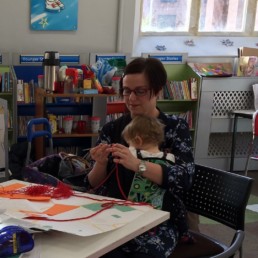
Creative Mothers Programme/GPS Embroidery by Lizzie Philps

It was a delight to partner up with The Mother House, Stroud as part of “GPS Embroidery”. This is a project which takes mothering arts practices beyond the domestic sphere by using the to and fro of the GPS signal to scrawl across city, suburban and countryside locations in an attempt to broaden ideas about who-gets-to-write-what-where in and about the British landscape. I have been running these workshops with people who mother in a variety of contexts, both alongside children and without, but this was a wonderful way not only to enable artist-mothers to keep working, but to broaden the audiences for our practices by carrying them out in the public space of the library.

Using a variety of playful mapping techniques, and with GPS trackers to trace their routes, participants created their own representations of the city. Whilst commuters may use maps as a tool to show main roads and businesses, we might not see the other, unpaid kinds of workers who are making paths through the streets. Whilst tourists might use maps to find sights and attractions, the details of life that escape the municipal overview are not often acknowledged or recorded, but are equally memorable and fascinating. Mapping allows us to experience details of the world we might otherwise miss, and to share a glimpse of these perspectives by exhibiting the maps in the library.
In parallel workshops facilitated by The Mother House Stroud’s Rebecca Stapleford and inspired by the stories of ‘A River’ by Marc Martin and ‘The Magic Paint brush’ by Julie Donaldson the group explored the theme of place using a variety of playful mapping and creative painting. The children’s work was exhibited in the library space, too.

The project was the starting point for Gloucester Library’s Creative Mothers Programme, which has been developed by producer Hannah Brady and aims to develop sustainable networks of mothers within the area.
The work has helped us explore the complications of making work with babes in arms and roaming toddlers and demonstrates the possibilities of what can be achieved in a short period of time within a supportive environment.
It was wonderful to work with such a creative and friendly group, and to be able to share our work with the library staff, visitors and general public. I hope that together we have helped to raise the visibility of maternal work (both artistic and caring) another notch, but I would like to give the final word to the artists:
These lines represent walks I have made with my daughter since becoming a mother. They portray a growing sense of discovery, beginning and ending from our secure base, our home. They begin small and close and with time they grow, branching out into new pathways. This is symbolic of the neurological development of an infant’s brain, and our journey together stepping out into a new world.
Ruth Bide
Drifting around the city I felt invisible. Everyone was going about their usual business but I felt unusual. My senses were heightened and everything was amplified. Sights, sounds, people, faces. I wanted to notice everything but it didn’t feel overwhelming. It felt glorious. As if I had permission to stop and stare, reflect and enjoy whatever caught my eye.
Sharon Bennett
When walking with the intention of observing I noticed details. I wouldn’t normally pay any attention to these details at all. As Sylvia slept in the pram, I took photos of these details then overlaid them on the map of Gloucester. I like the sense of scale between the items in the drawings and the streets represented by the map.
Athene Whitaker


Supported by Gloucestershire Art of Libraries, The Arts Council, Procreate Projects and inspired by Mother House Studio.
Participants: Chloe Kempton, Sharon Bennett, Athene Whitaker, Katrina Rosser, Jessica Timmis , Ruth Bide and Oonah Davies


Childhood memories by Mother Art Prize winner Mary Martins
Winner of the first Procreate Project Mother Art Prize, Mary Martins, has just finished her residency at the Mother House studio in Dagenham as part of her awards.
Here is an insight on what she has been working on and what are her plans for the future.
How has the Mother Art Prize helped your practice develop during the last few months?
Since receiving the Mother Art Prize last October, there has been a progressive yet significant shift in the perspective of my practice and artistic identity. The mentoring session from Sylvie Gormezano was extremely useful, with discussions surrounding creating work in the context of motherhood and expanding on my work within film and animation. Her advice really helped to untangle some creative blocks that I initially had about the direction that my work was taking.
‘The Divide’ was made at a very pivotal period on my creative journey, a stage where I really wanted to experiment with more abstract animation techniques and intertwine a clear narrative in relation to my own experiences of motherhood. I am extremely grateful for the positive responses I have received and to those it may have inspired.
It was also wonderful to see my work exhibited at the Left Overs exhibition and in a new environment as animators usually display their work at film festivals. What has really transpired, is that ‘The Divide’ can now be seen as a method of challenging the parameters of documentary practice through animation.
Shortly after making ‘The Divide’ I started to work on a new project which focuses on autobiographical memory in relation to identity and culture, and specifically my own cultural heritage. The place where our childhood memories go, is the theme that my new animated short will explore. For this animation, I’m working with rare archive footage of Nigeria in the 1970s to really draw out the richness of my heritage. I have the support of two other animators, which I believe will move by work away from the realm of moving image and experimental.
 I used the time at the Mother House Studio to complete the research and development stage for this project. I have created a blog where the public can comment on this theme and share their earliest childhood memory. Similarly to my own, others have reported that their earliest childhood memory was a significant event involving a parent or carer.
I am now at the pre-production stage; where I will create a story board and animatic with the view to start the production stage in June.
My ideas are still evolving, my craft is developing, but animation is very technical, so it requires a great deal of dedication and practice. I am very excited to see the results of this new direction.

More about the Childhood Memories project
Our earliest childhood memories, often episodic, are one of our most intimate experiences. Scientists believe that these can start from as little as 3 years old. After the age of 5 these memories become elusive. There is a mechanism behind the cognitive process that retrieves these abandoned memories or temporary cases of amnesia. A journey back to where it all began can often be painful, beautiful or enlightening or perhaps a combination of all three. There is a very faint line between our repressed memories and those that we may never remember. According to Freud, infantile amnesia ‘veils our earliest youth from us and makes us strangers to it’. Restoring these memories brings a purpose – We can use this as a way of learning more about our family background and about ourselves as an individual.
Cultural differences may offer an explanation as to why some memories are more vivid in our mind than others and why others remember more from their childhood. Certain experiences in our adulthood often trigger the re-possession of the earliest childhood memory. We sometimes need to attach to the initial relationship we once had with the world.

My earliest childhood memory is when I accompanied my mother to Lagos, Nigeria in 1987. I was 4 years old. I was too young to remain in London with my Father and my two older sisters.


Read more about Mary Martins last project here